Inexpensive Apartments in Raleigh, NC: An Honest Budget Map
A practical map of the budget apartment search in Raleigh, NC: low market-rate rent versus income-restricted housing, what really drives Raleigh rent down, the recurring-fee trap behind low headline rents, and where The Villages at Raleigh Beach (market-rate, not subsidised) fits.
If you are searching for inexpensive apartments in Raleigh, NC, settle one question before you open another listing tab: which kind of inexpensive you need. One kind is a low market-rate rent, where anyone can apply and the price is simply lower than the city average. The other is income-restricted or subsidised housing, which carries eligibility rules, income limits and, often, waiting lists. They are two different markets with two different search paths, and mixing them up costs weeks. This guide maps the market-rate side — what genuinely pushes Raleigh rent down, where the fees hide, and what to verify before you sign — and then places one Northeast Raleigh community, The Villages at Raleigh Beach, on that map. That community is market-rate housing. It is not income-restricted and it is not subsidised.
The two kinds of inexpensive, and how to tell which search you are running
Market-rate housing is priced by the owner against what the local market will bear. There is no income test, no programme application and no queue tied to eligibility. If a plan is available and you qualify under the property's standard screening criteria, you can lease it. A low market-rate rent is low because of where the building sits, how big the unit is, how old the building is and what the amenity package costs to run.
Income-restricted and subsidised housing works on a different mechanism entirely. Rent is capped or offset relative to household income under programmes with their own rules, and access is governed by eligibility and availability rather than by simply being the first applicant with a deposit.
If that second category is what you need, the market-rate listing sites most people start with are the wrong tool. Start instead with the Raleigh Housing Authority, which administers housing programmes for the city, and with listing filters that specifically flag income-restricted inventory as a category. Those are different searches with different timelines, and knowing which one you are running on day one is the single biggest time-saver in this process.
Everything below this point is about the market-rate side.
What Raleigh actually costs right now
A number to anchor against. RentCafe puts the average apartment rent in Raleigh at $1,588, with one-bedrooms averaging $1,409 across roughly 753 square feet and two-bedrooms averaging $1,655, on data updated 31 August 2026. The same source records the citywide average down about 1.6 percent year over year.
That matters more than it sounds. In a market that is flat to slightly softening, the gap between a well-priced apartment and an overpriced one is not luck — it is the specific set of trade-offs the building is asking you to make. Your job is to work out which trade-offs you are willing to take, rather than hunting for a bargain that has no cause behind it.
The four things that actually move rent down in Raleigh
Submarket. This is the biggest lever by a wide margin. The same floor plan, same age of building and same amenity package will price materially differently inside the downtown core than it will ten or fifteen minutes out. Most of what people experience as "finding a deal" in Raleigh is, underneath, a decision about commute distance.
Building age and condition. Older stock usually prices lower. That can be a genuinely good trade, but it is a real trade: older buildings more often mean older appliances, less insulation, higher utility bills and fewer in-unit conveniences. The rent line goes down and some other lines go up.
Unit size. Square footage is the most honest variable in the whole search. A smaller plan costs less because it is smaller. If you are comparing two one-bedrooms at similar rents, compare the square footage before anything else — a 687-square-foot plan and a 934-square-foot plan are not the same product even when the rents are close.
Amenity load. Pools, fitness centres and clubrooms cost money to run, and that cost sits inside rent somewhere. A low rent at a property with a heavy amenity package is unusual and worth understanding; a low rent at a property with no shared amenities is simply the maths working normally.
The low headline rent that is not actually low
The most common trap in a budget apartment search is the advertised rent that is genuinely low and the monthly total that is not. Recurring charges — which may include utility billing, administrative or service charges, parking, pet rent, package handling and similar items — are added monthly and compound across a twelve-month lease. A property that is $60 a month cheaper on the headline and $90 a month heavier on recurring charges is more expensive, and nothing on the listing page will tell you that.
So do not compare headline rents at all. Compare total monthly cost. Ask every property for its published recurring fee schedule in writing, read it line by line, and add it to the rent before you rank anything. Ask separately about one-time charges — application, administrative and deposit amounts — because those hit your move-in cash even though they do not change your monthly figure.
What to verify before you sign
Get the fee schedule in writing. Not a verbal summary on a tour. The published schedule, dated, so you can compare properties on the same basis.
Confirm how utilities are handled. Billed by usage, billed as a flat allocation, or partly included — these produce very different monthly totals in a Raleigh summer, and the difference is larger in older buildings.
Check lease term pricing. Rent at many properties varies by lease length. A twelve-month term and a seven-month term on the same unit can carry meaningfully different monthly rates.
Confirm the figure applies to a real available unit. Advertised pricing usually reflects specific units with specific availability dates. Ask what is actually available on your move-in date and what that specific unit prices at.
Price the commute. If a cheaper address adds twenty minutes each way, cost that in fuel and time before you call it a saving.
Where The Villages at Raleigh Beach sits on this map
The Villages at Raleigh Beach is at 2015 Wave Crest Drive in Northeast Raleigh. It is market-rate housing — no income restriction, no subsidy, no eligibility programme attached to it.
As of 1 October 2026, one-bedrooms here start in the high $1,100s, and the largest one-bedroom plan sits in the mid-$1,300s. Measured against RentCafe's citywide one-bedroom average of $1,409 on 31 August 2026 data, every one-bedroom plan at this community prices below that average — and the entry plan does so by a wide margin. Two-bedrooms start in the high $1,400s and run to the mid-$1,600s, which places the entry two-bedroom roughly $300 above the entry one-bedroom. The single three-bedroom plan sits in the low $1,800s, about $150 above the top two-bedroom.
Explore floor plans and pricing at Villages at Raleigh Beach
On the fee side, the published recurring fee schedule, checked 10 September 2026, lists no additional recurring fees. Utilities are billed separately by usage, and deposits and one-time charges are quoted by the leasing office. That is a meaningful detail in a budget search, because the recurring-charge stack is exactly where a low headline rent usually gets quietly undone.
What the entry price actually includes
This is where the community departs from the usual pattern. Normally, rent below the citywide average means a stripped-back amenity package. Here it does not.
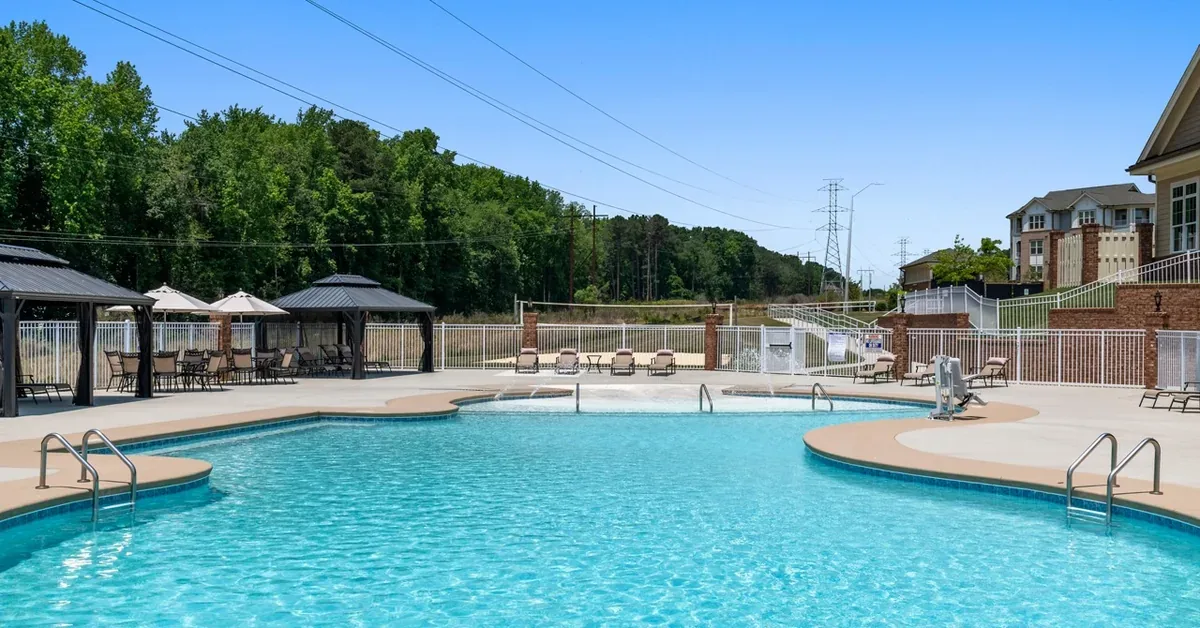
There are two pools, and one of them is indoors and heated — which means it is usable in February, not just July. That is the standout, and it is unusual at this price point in Raleigh. The outdoor pool is resort-style, with a sundeck and grills.
Beyond the pools there is a 24-hour fitness centre with a spin room, a virtual reality room, a theatre room, a game room with billiards and ping pong, a children's playroom, a sand volleyball court, a playground and a business centre.
See all amenities at Villages at Raleigh Beach
Unit sizes are the other half of the value question. The three one-bedroom plans are Design 1B at 687 square feet, Design 1C at 865 square feet and Design 1D at 934 square feet. The two two-bedroom plans run 1,183 and 1,263 square feet, and the three-bedroom is 1,429 square feet. Set the 865-square-foot and 934-square-foot one-bedrooms against RentCafe's 753-square-foot citywide one-bedroom average from 31 August 2026 and the space-per-dollar picture gets clearer.
The honest trade: a Northeast Raleigh address
None of that is free. The trade here is location, not building quality.
The address is Northeast Raleigh, about 13 minutes from downtown Raleigh and about 14 from Crabtree Valley Mall. If your daily life is anchored downtown and you want to walk to it, this is the wrong geography and the lower rent is the compensation for that.
What the location does give you is close-range practicality. The Neuse River Trail is about 3 minutes away, as are a Walmart Supercenter and an ALDI. WakeMed's Raleigh campus is about 6 minutes, which matters if you work there.
And the broader honesty point: inexpensive here is relative. There are cheaper apartments in Raleigh than this one. They will generally be older, smaller, further out, or carrying a lighter amenity package — sometimes all four. This community is not the cheapest rent in the city. It is a market-rate price below the citywide average attached to a newer building with a heavy amenity set, and the reason that combination is possible is the distance from downtown.
Who this is not the right fit for
If you need income-restricted or subsidised housing, this is not that, and no amount of negotiating changes it — start with the Raleigh Housing Authority and income-restricted listing categories instead.
If your absolute ceiling is below the high $1,100s as of 1 October 2026, this community will not reach you, and the honest answer is to look at older stock or further out.
If you want to walk to downtown restaurants and offices, 13 minutes by car is not that, and you should pay the downtown premium or pick a closer submarket.
And if you will never use a pool, a spin room or a theatre room, you are paying — through rent, as everyone does — for infrastructure you do not want. A plainer building would serve you better and probably cost less.
Schedule a tour at Villages at Raleigh Beach
Sources and check dates. Floor plans, square footage, amenities and the recurring fee schedule were verified against the community's published property feed and its own published articles on 1 October 2026; the recurring fee schedule was last checked 10 September 2026. Citywide Raleigh rent figures are from RentCafe, data updated 31 August 2026. Rents at this community are repriced frequently, so the bands above are ranges as of 1 October 2026 rather than quotes — confirm current pricing and availability for a specific unit directly with the leasing office. The Villages at Raleigh Beach is market-rate housing and is not income-restricted or subsidised.
Frequently asked questions
Is The Villages at Raleigh Beach income-restricted or subsidised housing?
No. It is market-rate housing. There is no income restriction, no subsidy and no eligibility programme attached to it. Anyone who meets the property's standard screening criteria can apply for an available unit.
What is the difference between a cheap market-rate apartment and income-restricted housing?
A market-rate apartment is priced against the local market and open to any qualified applicant; it is inexpensive because of its location, size, building age or amenity load. Income-restricted and subsidised housing caps or offsets rent relative to household income under programmes that carry eligibility rules and, frequently, waiting lists. They are separate markets with separate application paths.
Where should I search if I need income-restricted housing in Raleigh?
Start with the Raleigh Housing Authority, which administers housing programmes for the city, and use listing filters that flag income-restricted inventory as a category. Standard market-rate listing sites will not surface that inventory reliably.
What is the average rent in Raleigh right now?
RentCafe reports an average of $1,588 across all apartment sizes, with one-bedrooms averaging $1,409 at about 753 square feet and two-bedrooms averaging $1,655, on data updated 31 August 2026. The citywide average was down roughly 1.6 percent year over year on that data.
What do one-bedrooms cost at The Villages at Raleigh Beach?
As of 1 October 2026, one-bedrooms start in the high $1,100s and the largest one-bedroom plan sits in the mid-$1,300s. Pricing moves, so confirm the current figure for a specific available unit with the leasing office.
How much more is a two-bedroom than a one-bedroom there?
The entry two-bedroom runs roughly $300 above the entry one-bedroom as of 1 October 2026. Two-bedrooms range from the high $1,400s to the mid-$1,600s.
Are there extra monthly fees on top of rent?
The published recurring fee schedule, checked 10 September 2026, lists no additional recurring fees. Utilities are billed separately by usage, and deposits and one-time charges are quoted by the leasing office. Ask for the current schedule in writing before signing.
How big are the apartments?
One-bedrooms come in three plans: Design 1B at 687 square feet, Design 1C at 865 square feet and Design 1D at 934 square feet. The two two-bedroom plans are 1,183 and 1,263 square feet, and the single three-bedroom plan is 1,429 square feet.
Is the pool usable in winter?
One of the two pools is an indoor heated pool, so it is usable year-round. The second pool is a resort-style outdoor pool with a sundeck and grills.
How far is it from downtown Raleigh?
About 13 minutes by car. Crabtree Valley Mall is about 14 minutes, WakeMed's Raleigh campus about 6 minutes, and the Neuse River Trail, a Walmart Supercenter and an ALDI are each about 3 minutes away.
Why is rent lower here than the Raleigh average if the amenities are extensive?
The trade is location rather than building quality. The address is Northeast Raleigh, roughly 13 minutes from downtown, and that distance is what the lower price reflects. There are cheaper apartments in Raleigh, and they will generally be older, smaller, further out or lighter on amenities.